A bipartisan, bicameral group of Members of Congress is speaking up about ACHPs proposed changes to the regulations implementing Section 106 of the National Historic Preservation Act (NHPA)
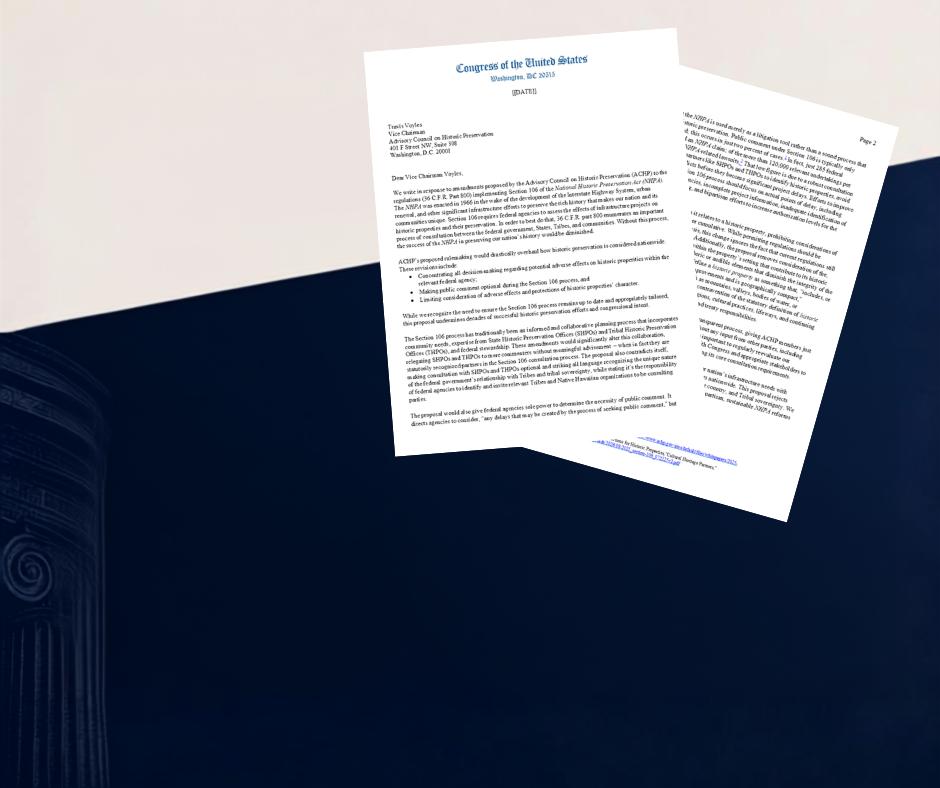
A congressional letter addressed to Advisory Council on Historic Preservation (ACHP) Vice Chairman Travis Voyles is now circulating in both chambers of Congress. The letter urges ACHP to reconsider its proposed overhaul of the Section 106 regulations and emphasizes the importance of preserving the collaborative consultation process that has been at the heart of Section 106 for decades.
The letter recognizes that the Section 106 process should continue to evolve and that there are legitimate opportunities to improve efficiency and predictability. But it also makes clear that reforms should not come at the expense of the consultation framework established by Congress.
A bipartisan, bicameral message
The letter is being led by Members from both parties, in both chambers.
Congressmembers wishing to lend their voice to this conversation can sign onto the letter through the Quill System. Note: The Quill link is accessible only to congressional offices.
SIGNATURE DEADLINE | October 30, 2026
Signatures as of 10.6.2026
HOUSE
- Gabe Amo (D-RI)
- Becca Balint (D-VT)
- Don Beyer (D-VA)
- Suzanne Bonamici (D-OR)
- Julia Brownley (D-CA)
- Nikki Budzinski (D-IL)
- Janelle Bynum (D-OR)
- Troy Carter (D-LA)
- Ed Case (D-HI)
- Emanuel Cleaver (D-MO)
- Sharice Davids (D-KS)
- Madeline Dean (D-PA)
- Diana DeGette (D-CO)
- Maxine Dexter (D-OR)
- Lloyd Doggett (D-TX)
- Sarah Elfreth (D-MD)
- Adriano Espaillat (D-NY)
- Dwight Evans (D-PA)
- Brian Fitzpatrick (R-PA)
- Robert Garcia (D-CA)
- Vicente Gonzalez (D-TX)
- Val Hoyle (D-OR)
- Jared Huffman (D-CA)
- Glenn Ivey (D-MD)
- Pramila Jayapal (D-WA)
- Hank Johnson (D-GA)
- Tim Kennedy (D-NY)
- Jennifer Kiggans (D-VA)
- Raja Krishnamoorthi (D-IL)
- Mike Lawler (R-NY)
- Teresa Leger Fernández (D-NM)
- John Mannion (D-NY)
- Doris Matsui (D-CA)
- Morgan McGarvey (D-KY)
- Analilia Mejia (D-NJ)
- Grace Meng (D-NY)
- Gwen Moore (D-WI)
- James Moylan (R-GU)
- Jerrold Nadler (D-NY)
- Eleanor Norton (D-DC)
- Alex Padilla (D-CA)
- Chellie Pingree (D-ME)
- Mark Pocan (D-WI)
- Aumua Amata Radewagen (R-AS)
- Emily Randall (D-WA)
- Andrea Salinas (D-OR)
- Janice Schakowsky (D-IL)
- Bradley Schneider (D-IL)
- Adam Smith (D-WA)
- Eric Sorensen (D-IL)
- Melanie Stansbury (D-NM)
- Greg Stanton (D-AZ)
- Marilyn Strickland (D-WA)
- Mark Takano (D-CA)
- Mike Thompson (D-CA)
- Rashida Tlaib (D-MI)
- Jill Tokuda (D-HI)
- Paul Tonko (D-NY)
- Mike Turner (R-OH)
- Gabe Vasquez (D-NM)
- James Walkinshaw (D-CA)
- Bonnie Watson Coleman (D-NJ)
SENATE
- Martin Heinrich (D-NM)
- Andy Kim (D-NJ)
- Ben Ray Lujan (D-NM)
- Jack Reed (D-RI)
- Adam Schiff (D-CA)
What Congress is concerned about
The letter identifies several concerns with ACHP’s proposed regulations, including provisions that would:
- Concentrate decision-making regarding potential adverse effects within federal agencies
- Make public participation in the Section 106 process discretionary
- Narrow the circumstances in which adverse effects to historic properties are considered
- Limit consideration of setting and other characteristics that contribute to a property’s historic significance
- Redefine “historic property” in ways that could exclude important landscapes and other places of cultural significance
- Reduce the meaningful role of SHPOs and THPOs in the consultation process
The letter also raises concerns about the treatment of Tribal interests, including the proposed removal of language recognizing the federal government’s unique relationship with Tribes and Tribal sovereignty.
These are not minor regulatory tweaks. They could fundamentally change how Section 106 consultation works across the country.
Questions may be directed to:
- U.S. HOUSE | Eric Dunay, Eric.Dunay@mail.house.gov
- U.S. SENATE | Maya Herman, Maya_Hermann@energy.senate.gov
Focus on the real sources of delay
Importantly, the Members of Congress also make a point that should sound familiar to anyone who actually works in Section 106:
If the goal is to make the process faster and more predictable, reforms should address the actual sources of delay.
The letter identifies issues including:
- Delayed initiation of consultation by federal agencies
- Incomplete project information
- Inadequate identification of historic properties
- Insufficient agency staffing
- The need for additional investment in the Historic Preservation Fund
These are practical issues that can affect projects every day. They are also issues that can be addressed without dismantling the consultation framework that makes Section 106 work.
Congress is paying attention to what happens next with Section 106
The Section 106 regulations can and should be improved where improvements are warranted. But changes of this magnitude deserve meaningful engagement with Congress, States, Tribes, local communities, and the preservation professionals who implement Section 106.
The more Congressmembers who hear from their constituents and sign onto this letter, the clearer the message is that Section 106 reform deserves a thoughtful, transparent, and collaborative process.