The National Conference of State Historic Preservation Officers
Section 106: The Tool No One is Talking About
—
5–7 minutes
The latest Nationwide Programmatic Agreement for federal transmission infrastructure highlights an underused tool already available to make Section 106 faster, more predictable, and more effective — without eliminating meaningful consultation.
On July 22, 2026, the NCSHPO Board voted unanimously to approve the Nationwide Programmatic Agreement (NPA) for Routine Transmission Operations and Maintenance Undertakings (“Transmission NPA”) jointly proposed by the Bonneville Power Administration (BPA), the Southwestern Power Administration (SWPA), and the Western Area Power Administration (WAPA).
This new agreement covers activities associated with existing transmission infrastructure across 29 states, where the agencies together maintain more than 34,000 miles of transmission lines and 600 substations, as well as over 1,000 communications sites and structures and tens of thousands of miles of access roads.
The Advisory Council on Historic Preservation (ACHP) describes Programmatic Agreements as one of the most commonly used program alternatives. They allow federal agencies to establish procedures for implementing a particular agency program or addressing complex projects or multiple similar undertakings through a negotiated agreement with the appropriate SHPOs and/or THPOs and the ACHP.
In other words, existing regulations governing the Section 106 process already recognize that one-size-fits-all, project-by-project review is not always the best solution. Agencies and consulting parties can tailor 106 to the nature of a program, the types of undertakings it routinely involves, and the historic properties that may be affected.
The ACHP itself explains that program alternatives can “improve the effectiveness and efficiency of Section 106 reviews and streamline routine interactions while focusing effort on the more complex projects or historic properties most important to communities.”
That is precisely what this Transmission NPA does. By engaging with stakeholders through multiple webinars and inviting feedback from SHPOs and Tribes in the early concept stages and on subsequent draft documents, the agencies were able to craft an agreement informed by a wide range of knowledge and perspectives.
The result is a document that reflects the many viewpoints of stakeholders and respects the consultative spirit of the National Historic Preservation Act.
Fully executed on August 24, 2026, this new NPA allows the agencies to handle routine, repetitive, and low-impact operations and maintenance activities without project-by-project consultation, significantly reducing review time for an estimated 200 to 600 undertakings per year nationwide.
This frees more resources for agencies and stakeholders alike to focus consultation on more complex undertakings with greater potential for impacts and stands as a strong example of the efficiencies that are created through Programmatic Agreements through existing regulations.
Better Consultation Through Better Targeting
The efficiency of a Programmatic Agreement does not come from eliminating consultation. Rather, it comes from doing more of the right consultation up front.
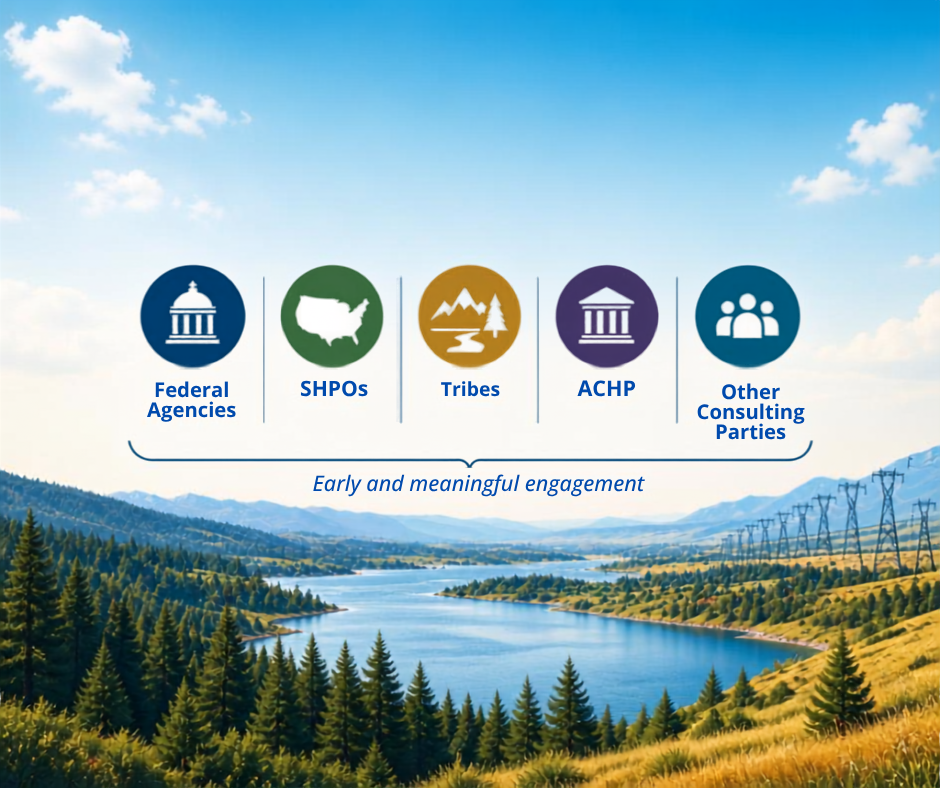
A Programmatic Agreement is not simply a federal agency creating its own arbitrary shortcut. It is a negotiated framework developed with input from the agencies, SHPOs, Tribes, ACHP, and other consulting parties.
Instead of repeatedly asking the same questions about routine activities, the parties work together to identify recurring issues, establish appropriate parameters, and agree in advance on how those activities will be addressed.
Good streamlining reduces repetition, rather than eliminating expertise.
That capacity is important for SHPOs and Tribes. Time spent reviewing routine, low-impact activities is time not spent on complex infrastructure projects, threatened historic properties, or undertakings where consultation can meaningfully influence the outcome.
The objective should not be to eliminate consultation. It should be to focus consultation where it matters most
This is exactly the principle the ACHP identifies in its description of program alternatives: they can focus effort on the more complex projects or historic properties most important to communities.
The Transmission NPA shows how this principle can work at scale. Rather than requiring agencies, SHPOs, Tribes, and other consulting parties to revisit the same questions each time a similar activity occurs, the agreement creates predictable procedures for recurring work while preserving additional review where circumstances require it.
Federalism in Practice
The Transmission NPA also demonstrates something important about the role of states and Tribes in the federal decision-making process.
A national program can have a consistent framework without presuming that every historic property, landscape, community, or Tribal interest is the same.
The federal government establishes the framework, while states and Tribes bring knowledge and expertise about the places where federal actions actually occur.
Federal agencies, SHPOs, THPOs, Tribes, and other consulting parties can then establish a process that is nationally useful while still informed by local and regional knowledge. That is federalism in practice.
It is also a better model than moving decision-making away from the people and institutions with expertise about the resources at issue.
Clear federal standards and meaningful state and Tribal participation are not competing goals. They can reinforce one another.
A Solution in Search of a Problem?
Current efforts to fundamentally remake Section 106 through broader permitting reform including ongoing congressional negotiations and the ACHP notice of proposed rulemaking, appear to overlook a much simpler solution: making better use of ACHP program alternatives already available.
NCSHPO supports thoughtful improvements to Section 106 that make reviews more efficient, predictable, and responsive to the needs of federal agencies and project proponents. However, policymakers should be expected to better identify specific barriers and develop targeted solutions, rather than simply seeking to narrow or bypass existing processes.
There are real opportunities to improve implementation. Reviews can be delayed when consultation begins too late, when project information is incomplete, when agencies lack adequate staff, or when parties have not established clear procedures for recurring activities.
But those challenges are not necessarily failures of the statutory consultation framework. A regulatory or legislative rewrite that reduces the voices at the table may not solve those problems. It could simply create new ones.
The Transmission NPA is not the only example. The ACHP maintains a nationwide collection of Programmatic Agreements covering federal programs ranging from land management and military facilities to broadband, telecommunications, housing, and other federal activities. Agencies have increasingly recognized the usefulness of such agreements. In the last three years alone, the Department of Homeland Security, the Department of Veterans Affairs, the National Park Service, and NASA have all collaborated with stakeholders to develop their own nationwide agreements. Other agencies, like the Bureau of Land Management, have consulted to extend agreements that have guided them for years.
As is true of all processes, Section 106 can be made faster, more predictable, and more targeted — without sacrificing the consultation, expertise, and accountability that make the process work.
Before Congress or federal agencies fundamentally rewrite Section 106, efforts should first be made to use the flexibility already built into the existing process.
10 Recommendations for Efficient and Effective Federal Review Section 106 can be made more efficient, predictable, and responsive to project needs without compromising the consultation Congress established under the National Historic Preservation Act. Consultation is not the problem to be solved. It is what gives federal agencies the information they need to understand the places […]
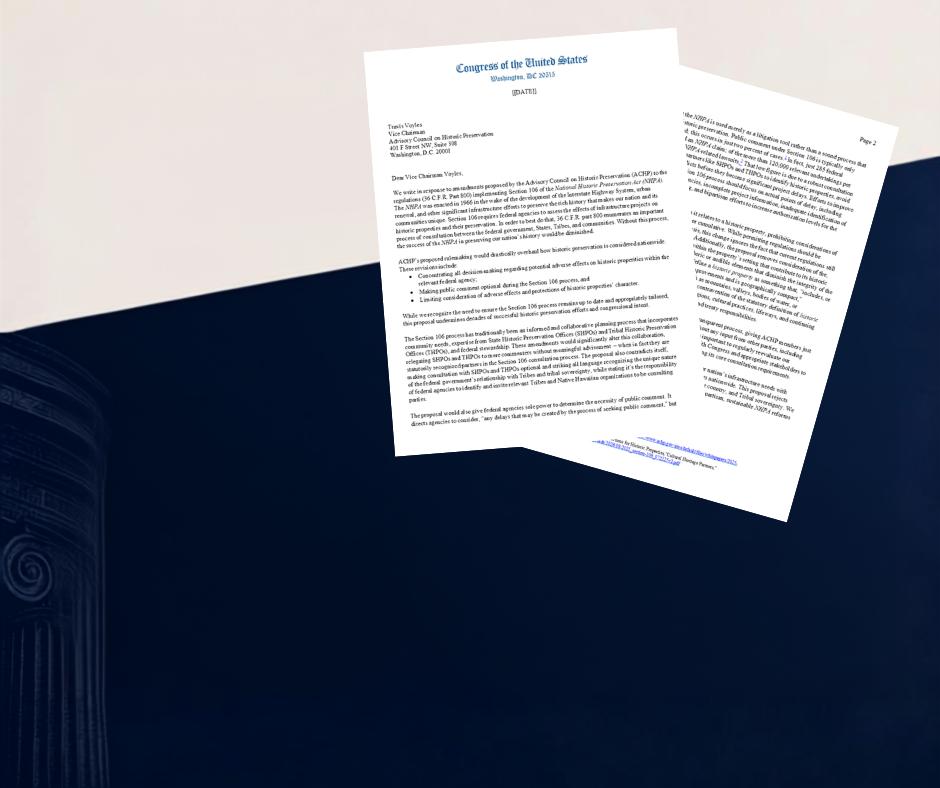
A bipartisan, bicameral group of Members of Congress is speaking up about ACHPs proposed changes to the regulations implementing Section 106 of the National Historic Preservation Act (NHPA) A congressional letter addressed to Advisory Council on Historic Preservation (ACHP) Vice Chairman Travis Voyles is now circulating in both chambers of Congress. The letter urges ACHP […]
In a recent letter, NCSHPO addressed the leaders of the Senate Energy and Natural Resources and House Natural Resources Committees, urging Congress to oppose the Advisory Council on Historic Preservation’s (ACHP) proposed rewrite of the regulations governing Section 106 in its current form — and to continue working with states and other stakeholders on targeted […]
There’s a familiar pattern emerging in the debate over infrastructure permitting. A report is released. A hearing is held. An op-ed (or two, or three, or four) appear. Before long, Section 106 of the National Historic Preservation Act is cast as one of the chief reasons America can’t build. It’s a compelling narrative, but if […]