10 Recommendations for Efficient and Effective Federal Review
Section 106 can be made more efficient, predictable, and responsive to project needs without compromising the consultation Congress established under the National Historic Preservation Act.
Consultation is not the problem to be solved. It is what gives federal agencies the information they need to understand the places communities value and make better-informed decisions. Without that dialogue, the risk is making decisions without knowing what matters on the ground.
If the goal is a Section 106 process that works better, the most effective reforms should target the demonstrated causes of delay: late initiation, incomplete information, insufficient agency capacity, inconsistent procedures, and limited use of programmatic tools.
There is a practical path forward. Improve implementation. Strengthen capacity. Use the tools already available to make the process more efficient and predictable.
Here are 10 ways to do it.
1. Start Section 106 early in federal project planning
Federal agencies shall initiate Section 106 within an appropriate project planning timeline, and must provide complete information to consulting parties, establish clear communication methods and timelines, and maintain qualified staff and sufficient capacity to manage reviews.
Agencies should:
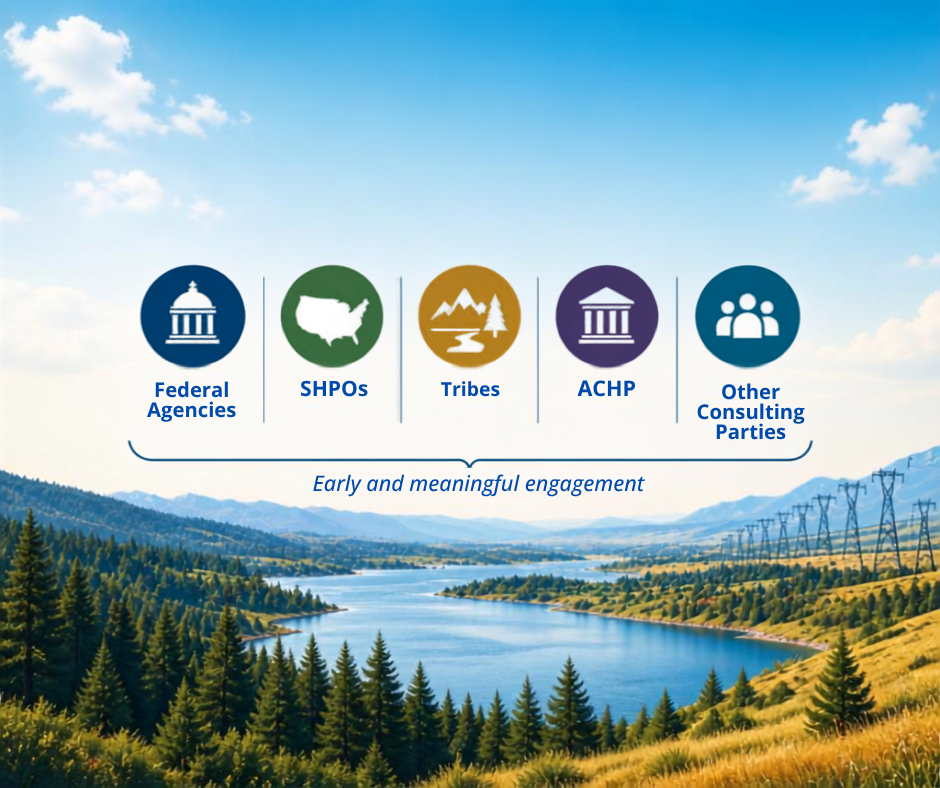
- Begin Section 106 consultation early in project planning; early coordination means federal agencies coordinate with SHPOs about the Section 106 process – the identification process should not be based on assumptions about SHPO “requirements”, but rather, on analytical review of the project area
- Where applicable, coordinate Section 106 initiation with NEPA, keeping in mind that both processes must be satisfied separately. SHPOs can help advise!
- Provide timely and useful information to consulting parties on an ongoing basis
- Establish regular and ongoing communication with consulting parties, including regular status updates and clear timelines for response and action
- Maintain sufficient staff with appropriate professional qualifications and training to perform identification and assessments
- Establish clear points at which the consultation process can move forward
- Use a professional mediator or facilitator for complicated undertakings that involve multiple agencies, Tribes and states
Why this improves efficiency: Late initiation, incomplete submissions, and insufficient agency capacity are significant sources of delay. Early initiation means that consulting parties can address the most obvious areas of concern as soon as possible. Addressing process issues improves timeliness and predictability without relying on rigid, one-size-fits-all deadlines that do not account for project complexity.
2. Expand and improve programmatic approaches
Federal agencies and consulting parties should work together, through the ACHP, to expand the use of already-allowed programmatic agreements for recurring, low-impact, repetitive, and large-scale activities where agencies, SHPOs, THPOs, and other stakeholders can establish streamlined procedures in advance. Programmatic agreements are particularly important for their ability to tailor expedited consultation to each state’s particular archaeological and built environment.
Programmatic approaches should be designed to:
- Address routine activities consistently
- Establish predictable procedures before individual projects begin
- Reduce repetitive consultation
- Preserve flexibility to address circumstances that warrant project-specific review
Why this improves efficiency: Programmatic approaches can provide meaningful efficiency gains while preserving consultation and historic property protections. Federal agencies, SHPOs, and the ACHP have long used programmatic agreements to establish predictable, negotiated approaches for recurring or complex activities. Strategic streamlining through negotiated, predictable procedures is generally more durable than categorical exclusions or ad hoc agency-specific approaches.
Strategic streamlining through negotiated, predictable procedures is more durable than ad hoc shortcuts.
3. Clarify roles and responsibilities
Federal agencies should establish clear responsibility for Section 106 coordination on projects involving multiple federal agencies and improve procedures for delegation to applicants and other responsible parties. This should be paired with clear expectations for moving the Section 106 process forward in a timely, deliberate, and well-documented manner, rather than relying on unilateral decisions or shortcuts when consultation becomes complex.
Federal agencies should:
- Designate a lead federal agency for undertakings involving multiple agencies
- Establish clear procedures for delegating Section 106 responsibilities to applicants where appropriate
- Provide adequate training and guidance for applicants, consultants, and delegated parties assuming federal agency responsibility for fulfilling the Section 106 process
- Consider establishing programmatic agreements before delegating recurring or large-scale activities
- Use mediation or facilitation for large complex undertakings involving multiple states, tribes and consulting parties
Why this improves efficiency: Clarity reduces duplicative coordination, uncertainty, and back-and-forth among agencies and project proponents. A designated lead agency can keep consultation moving, ensure decisions are made on a defined record, and provide a clear path for resolving disagreements. Better delegation can also reduce the amount of basic process education that falls to SHPOs, allowing them to focus their limited capacity on substantive review.
Better delegation can also reduce the amount of basic process education that falls to SHPOs, allowing them to focus their limited capacity on substantive review.
4. Standardize routine processes to improve predictability
Develop template forms, guidance documents, and baseline standards for routine aspects of Section 106 while preserving appropriate state, Tribal, and project-specific flexibility.
Potential areas for greater consistency include:
- Model agreement templates
- Guidance for recurring project types
- Guidance for contacting consulting parties, especially Tribes
- Expectations for the information needed to support eligibility and effects determinations
- Expectations for baseline submissions
- Expectations for timeframes
- Improved guidance for mitigation strategies
Why this improves efficiency: Greater consistency can reduce uncertainty for agencies, project proponents, and consulting parties and make it easier to identify and resolve routine issues. Standardization should establish useful common baselines rather than impose a one-size-fits-all process where state, Tribal, or project circumstances warrant flexibility.
5. Invest in data and technology
Invest in modern digital records, GIS, and related technology for SHPOs and THPOs so historic property information can be accessed and incorporated into project planning earlier.
SHPOs and THPOs should:
- Continue to be the repositories for historic property information as described in the NHPA
- Receive funding to improve the accessibility of historic property information provided by agencies and others, making it available to the public and for other project planning purposes
- Receive funding to perform historic property surveys and other studies to improve the knowledge base and streamline future projects
Why this improves efficiency: More accessible and complete information can support early identification of potential issues, improve project planning, reduce duplicative work, and help prevent avoidable conflicts from becoming project delays. Relatively modest investments in surveys, data, and technology can generate substantial downstream savings by allowing agencies and project proponents to identify and address potential issues before project decisions are locked in.
Relatively modest investments in surveys, data, and technology can generate substantial downstream savings by helping agencies and project proponents identify and address potential issues before project decisions are locked in.
6. Invest in SHPO and THPO capacity
Provide sustained, predictable federal funding to ensure SHPOs and THPOs have the capacity to carry out their responsibilities under the NHPA in a timely and effective manner.
Capacity matters: Annual Historic Preservation Fund formula grants provide the core federal investment supporting the work of State and Tribal Historic Preservation Offices. In FY2026, Congress provided an investment of $85.9 million ($62.15 million for allocation among 59 SHPOs, and $23.75 million amongst 235 THPOs). Strengthening this capacity is an important component of improving the timeliness and predictability of federal review.
Why this improves efficiency: Adequate and predictable SHPO and THPO capacity is essential to timely consultation, review, coordination, and technical assistance. Strengthening this capacity can help offices respond more consistently to project demands, reduce bottlenecks, and improve the timeliness and predictability of federal review.
7. Equip project proponents w/better information early on
Congress should provide funding to support additional National Context Studies, proactive surveys of previously unstudied areas, and readily accessible technical guidance for common property types and recurring issues.
Context studies and surveys:
- Are undertaken by professionally qualified staff members or consultants
- Are valuable in identifying broad patterns of history and development, helping to identify and keep pace with property types or themes that are “aging in” to consideration for National Register eligibility
- Can proactively “fill in the blanks” where property information is missing, before project schedules become critical
- Can help federal agencies fulfill their Section 110 responsibilities by developing the information needed to identify and evaluate historic properties before individual undertakings arise
Why this improves efficiency: Clearer information about common property types, historic contexts, eligibility considerations, and potential effects can help project proponents and agencies make more timely and consistent determinations and reduce unnecessary back-and-forth during consultation. Availability of information shifts work from project-by-project discovery to proactive planning — exactly the kind of upfront investment that can make Section 106 more efficient.e planning. That is exactly the kind of upfront investment that can make Section 106 more efficient.
8. Clarify guidance and improve interagency coordination
The ACHP should provide clearer guidance on areas of recurring uncertainty, including the definition of the Area of Potential Effects, effects determinations, and eligibility. The existing regulations provide agencies with important flexibility to exercise professional judgment and tailor the process to the undertaking. The challenge is ensuring agencies have sufficient clarity and support to exercise that flexibility effectively and with confidence.
The goal should be to clarify how the existing requirements work in practice while providing greater predictability about when additional analysis is necessary and when agencies can move to consideration of avoidance, minimization, and mitigation. Clearer guidance can reduce risk aversion and help agencies make timely, informed decisions rather than delaying action because of uncertainty about the appropriate course.
Guidance should clarify:
- How the significance or integrity of properties may be affected by projects or actions
- How the APE may vary by project and resource type
- That defining the APE is part of the consultation process, not independent from it
- How to move ahead in consultation if disputes about APEs, eligibility, and effects are unresolved
Why this improves efficiency: Clearer guidance can improve consistency and reduce avoidable disputes while helping agencies and project proponents understand what information is needed and when. The objective should not be to eliminate agency discretion, but to provide the guidance and tools needed to use that discretion effectively.
The objective should not be to eliminate agency discretion. It should be to give agencies the guidance and tools they need to use that discretion effectively.
9. Measure where the process is working, and where it is not
The ACHP, in coordination with federal agencies, should develop a common framework for collecting and reporting on data relevant to Section 106 performance and outcomes. Federal agencies should collect and report consistent data that can identify the actual sources of delay in Section 106 and allow policymakers to target reforms accordingly.
Before making changes of this magnitude, policymakers should have a clear, evidence-based understanding of where and why the current process is producing delays or other inefficiencies. The record should include consistent, verifiable data sufficient to distinguish problems with the Section 106 process itself from delays caused by agency capacity, project development, incomplete information, or other factors.
Useful measures could include:
- Time from project initiation to commencement of consultation
- Time spent awaiting action or information from each participant in the process
- Frequency and causes of incomplete submissions by federal agencies and project proponents
- Use and effectiveness of programmatic agreements
- Recurring sources of consultation or coordination problems
Why this improves efficiency: Better data can distinguish delays caused by Section 106 requirements from delays caused by agency capacity, project development, incomplete information, or other factors. That allows policymakers to focus reforms where they are most likely to produce measurable improvements. It also helps ensure that significant changes to a longstanding statutory process are targeted to documented problems rather than assumptions about where inefficiency occurs.
In other words: measure the problem before redesigning the process.
10. Move from mapping to mitigation
For large-scale and linear projects, focus on reasonable, proportionate avoidance, minimization, and mitigation rather than prolonged disputes over APE boundaries or effect classifications.
Where additional identification or evaluation is unlikely to change the project decision, agencies should consider presuming properties eligible and moving to effects and mitigation, while preserving opportunities for SHPOs, THPOs, Tribes, and other consulting parties to provide relevant information.
Agencies should:
- Focus intensive identification and archaeological work where it could affect project decisions
- Avoid unnecessary excavation in areas that will not be disturbed
- Use programmatic approaches to establish mitigation frameworks for recurring impacts
- Outline steps to continue the process where reasonable mitigation is not possible
- Hire a facilitator or mediator if needed.
Why this improves efficiency: Focusing resources on potential impacts and practical solutions can reduce disproportionate time spent debating APE boundaries or effect classifications without artificially narrowing the scope of review. In other words, resolve uncertainty rather than define it away.
In other words: resolve uncertainty rather than define it away.
A Practical Path Forward
There is no reason to choose between an efficient Section 106 process and meaningful historic preservation.
The goal should not be to make historic properties disappear from review. It should be to make the process of addressing them more predictable, proportionate, and effective.
The biggest opportunities are practical:
- Start earlier
- Leverage existing tools
- Clarify responsibilities
- Standardize processes
- Invest in technology & data
- Strengthen capacity
- Provide better information
- Improve guidance & agency coordination
- Measure what is actually causing delay
- Focus on mitigation
Those are not radical changes. They are targeted improvements to a process that already has many of the tools needed to work better.
If policymakers want Section 106 to be faster and more predictable, the best place to start is by fixing the problems that actually cause delay.